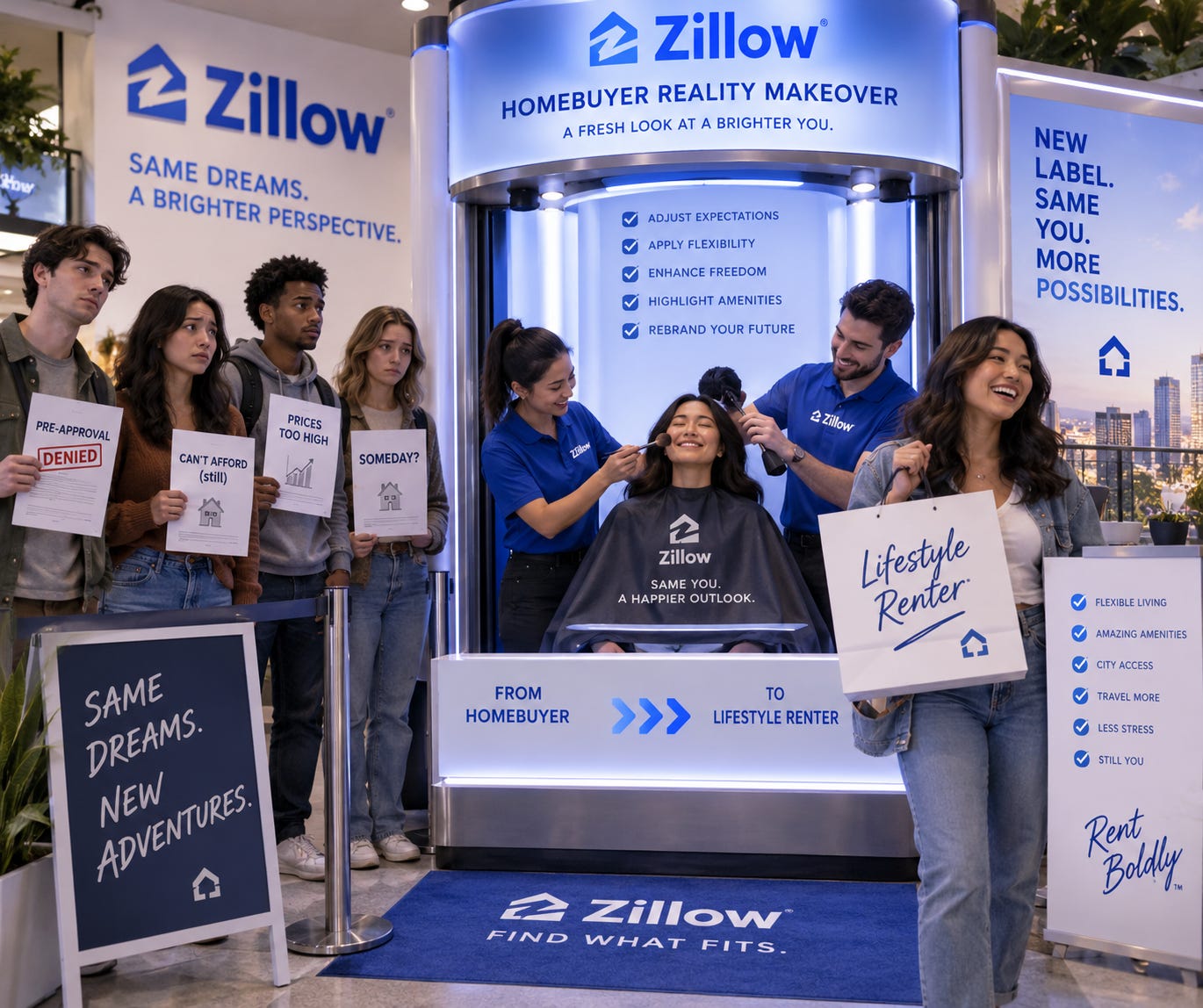
Zillow says something interesting is happening to the American renter.
Section: Market Decoder
Author: Susan Isaacs, Washington DC Real Estate Strategist
Once viewed largely as a temporary stop on the way to homeownership, renting is increasingly becoming a deliberate long-term choice, Zillow claims. It calls the people making it “lifestyle renters.”
Renting Is A Legitimate Long-Term Option, Not A Fallback
So says Zillow Chief Economist Mischa Fisher.
For some people, it absolutely is.
But Zillow points to another statistic as evidence of this changing attitude: Only 42% of renters say they would be very or extremely likely to buy a home if mortgage rates fell. That statistic is generating headlines suggesting that lower mortgage rates may no longer be enough to bring renters into the housing market.
So I asked one rather important question:
Could these renters afford to buy a house in the first place?
If not, Zillow is just repackaging priced-out buyers and those who may not qualify for a mortgage “lifestyle renters” when they’re really “buyer wannabes.” So let’s find out.
Who Are the 42%?
Zillow’s 2025 Consumer Housing Trends Report is a substantial study. It includes information from more than 24,400 unique renters and is weighted to be nationally representative of U.S. renter households.
But Zillow didn’t assemble a sample of mortgage-qualified prospective homebuyers and ask whether they preferred renting. It used a much broader definition of “renter”: an adult household decision-maker who rents their primary residence.
No requirement that respondents have sufficient income to buy a home
No requirement that they have adequate credit
No minimum down payment
No debt-to-income qualification
No requirement that an affordable home actually be available in the place where they live.
When we use the responses from this broad survey to draw conclusions about how many people are choosing renting over an attainable alternative of homeownership, meaning they’d qualify for a mortgage and feel comfortable with the payment, that’s a problem.
Zillow’s Renters Aren’t Exactly Lousy With Purchasing Power
The demographics make the problem clearer.
The median household income among renters in Zillow’s survey was about $54,000, compared with approximately $80,000 for U.S. households overall.
Half of renter households earned less than $50,000.
Only 20% earned $100,000 or more.
And Zillow has another piece of research that’s particularly revealing.
Back in April 2026, Zillow estimated how many renters in their prime homebuying years actually had enough income to afford the monthly cost of the typical home in their market with only 5% down.
The answer was 20.4%. About 3.2 million households.
That calculation doesn’t establish that all 20.4% could actually get a mortgage. Income sufficient to carry the payment doesn’t tell us whether a household has the necessary credit history, debt-to-income ratio, down payment and closing funds needed to qualify, either.
But it does tell us something important about the other roughly 80%.
Most homebuying-age renters couldn’t even clear Zillow’s income affordability test for the typical home in their own market.
That’s Zillow’s “lifestyle renter.” If we’re going to identify a cultural shift away from homeownership, shouldn’t we first separate those people from renters who would prefer to buy, but can’t? Zillow’s 42% statistic doesn’t do that.
There are undoubtedly some who would simply prefer to rent. Flexibility has value. Some people don’t want a long-term commitment. Others worry about responsibility for repairs and maintenance. Some don’t know where they’ll be living five years from now and still others may run the numbers and rationally conclude that their capital is better invested somewhere other than a house. I know some of them, and respect those choices. But labeling it a trend and inflating their numbers is a dishonest portrayal.
67% Show Measured Interest in Buying if Rates Fall
There’s something else odd about the way the 42% number is being interpreted by Zillow.
It asked renters how likely they would be to buy if mortgage rates fell:
20% said extremely likely.
22% said very likely.
25% said somewhat likely.
Put those together and 67% of renters expressed at least some inclination toward buying if mortgage rates declined. Only 33% said they were not very likely or not at all likely.
And remember: That’s among all renters, not a pool of people Zillow determined were financially capable of purchasing a home.
That sounds like mortgage rates do matter.
Zillow’s own heading for this section of its renter report concedes this: “Lower rates could turn more renters into home buyers.”
But somehow (The Street, I’m looking at you), that has been amplified into one about lower rates not being enough to incentivize renters into homeownership.
Zillow’s Other Numbers Don’t Look Much Like a Rejection of Homeownership, Either
The 42% figure becomes even harder to characterize as evidence of a broad lifestyle shift when we look at the rest of Zillow’s survey.
Among recent renters, 64% considered buying a home during their housing search in 2025. Compared to 66% in 2022. Not exactly a collapse in interest.
Among renters considering a move within the next three years, 56% say they intend to save enough for a down payment or to buy a home outright.
And the percentage of renters saying they’d be very or extremely likely to buy if mortgage rates fell doesn’t exactly reek of disinterest, either:
2023: 45%
2024: 37%
2025: 42%
If Americans were rapidly abandoning the aspiration of homeownership in favor of being “Lifestyle Renters” these numbers don’t demonstrate it.
Then There’s the Problem of What You Can Actually Buy
For would-be buyers in high cost areas like Washington DC, mortgage qualification isn’t the only constraint.
A renter can have excellent credit, a solid income and money in the bank and still discover that the homes available within their purchasing power aren’t particularly appealing. They see condo values in the District dropping, a severe lack of starter single family homes in neighborhoods they’re targeting, and little hope of that changing any time soon. Maybe it will even get worse. They could buy a fixer, if they had the cash to pump into it after purchasing costs, but now they need to be wary of DC’s new Construction Code changes and the devastating Level 3 trap included in them (post on this coming soon). So what’s a wannabe to do?
Zillow’s own research tells us location matters enormously to renters. 81% say their preferred neighborhood or location is essential. Among recent renters, 57% consider the commute to work or school very or extremely important, while 55% say the same about neighborhood walkability.
So maybe just rent in the location they want, and wait.
But that’s less a choice than it is a concession.
Sometimes Renting Really Is the Smarter Choice
None of this means Zillow is wrong about the economics of renting.
In fact, its rent-versus-buy research makes a pretty compelling case that renting can be the rational financial choice in some circumstances. Zillow estimates that buying becomes financially advantageous nationally after approximately six years under its model. But the calculation varies dramatically by location. Its more recent analysis puts the single-family homeownership breakeven period in the Washington metro at approximately 11.4 years. Ooof. That’s significant. Of course that doesn’t include popular DC housing hacks like renting the basement, leveraging the property to purchase another, etcetera.
And prices are still softening, which means equity build isn’t what it once was in DC (and will be at some point again). So someone who expects to relocate in four years may be making an entirely rational decision by renting, even if that person could easily afford to buy. There’s no percentage in it.
They can take their $150,000 down payment and invest it instead.
That’s math, not a lifestyle decision.
Zillow Itself Calls Them “Would-Be Buyers”
Here’s where the terminology gets particularly interesting.
In other Zillow research discussing the rental market, the company has acknowledged that elevated home prices and mortgage rates have pushed “would-be buyers” toward renting single-family homes. That’s a much better description of at least part of this population.
These households may want the space and lifestyle associated with homeownership but find that renting the house is substantially less expensive than buying it. That’s not necessarily a rejection of homeownership. It’s a response to home prices.
And price-sensitive behavior can change when prices, mortgage rates, incomes or available inventory change.
Zillow Can’t Seem to Decide Who These Renters Are
Oddly enough, Zillow itself doesn’t always describe these renters as “lifestyle renters.”
In August 2026, Zillow calculated that the annual income needed to afford the typical home purchase was more than $21,000 higher than the income required to afford the typical rental. Its conclusion? That affordability gap is keeping “would-be buyers” in the rental market.
Zillow’s August housing forecast was even more direct. It said affordability constraints are keeping would-be buyers on the sidelines and “in rentals longer than they might otherwise choose.”
There’s nothing new about the affordability story. Home prices rose dramatically, mortgage rates more than doubled from their pandemic-era lows, and prospective buyers lost purchasing power. We’ve been talking about would-be buyers remaining renters for years.
“Lifestyle renters,” on the other hand, has a certain ring to it. Clickbait.
We’re not witnessing a meaningful cultural shift toward renting by choice. Zillow is just relabeling packaging the people we’ve been talking about all along: prospective buyers who looked at the cost of homeownership and decided, or were forced, to wait.
Disclaimer
We are not attorneys, legal experts, investment counselors, or CPAs. The content on this channel is presented for informational purposes only and derived from reliable sources, but should not be considered legal, financial, investment, transaction or real estate practice advice. Susan Isaacs and Compass, their principals and/or representatives, do not guarantee or warrant its accuracy, completeness, or applicability to any specific real estate transaction. Homebuyers should read applicable D.C. law and code as part of their due diligence, and seek help from licensed, qualified professionals for interpretation and application to their specific transaction.


