


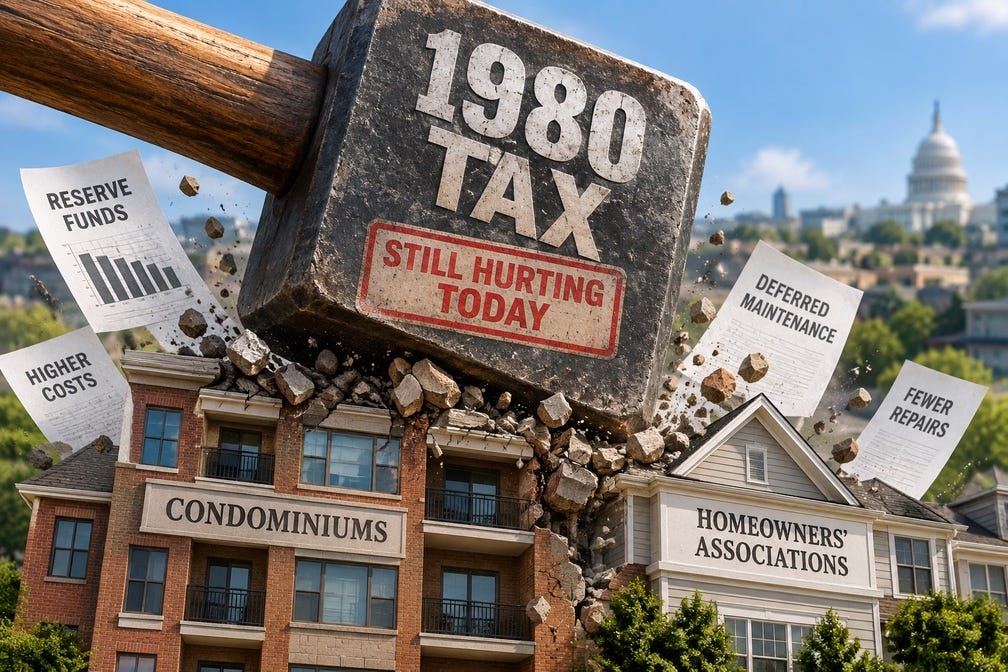
The 46-Year-Old Tax Shrinking Your Condo Reserves
Section: Market Decoder
Author: Susan Isaacs, Washington DC Real Estate Strategist
Doris Goldstein, a longtime advocate on condominium and HOA issues, posted something that stopped me: condominium and homeowners’ association reserve funds can be paying federal income tax at a 30% rate on taxable income such as interest.
The rate was an eye-catcher.
I spend an unreasonable amount of time thinking about condos, reserve funding and the growing pile of financial pressures being placed on condominium owners. I knew reserve-fund interest could be taxable. The number was what sent me down the rabbit hole.
And there was a much bigger story hiding down there.
Hello, 1980
The 30% rate dates to the Homeowners’ Associations Act of 1980.
Ronald Reagan hadn’t been inaugurated yet. The top individual federal income tax rate was 70%. Mortgage rates were heading toward the stratosphere. Congress was trying to establish clearer tax treatment for homeowners’ associations.
Forty-six years later, much of the tax system around that law has changed.
But the 30% rate hasn’t.
That might have remained an obscure little tax curiosity except something else has changed dramatically: the amount of money condominium associations are increasingly expected to keep in reserves.
Buildings are aging. Repairs cost more. Insurance costs have climbed. Structural safety has received far more scrutiny since Surfside. Fannie Mae and Freddie Mac are tightening their attention to reserves, deferred maintenance and project financial health and the GSEs’ minimum requirement for reserves is rising to 15% in January.
Condo associations are being told to save more money, and they should. But at the same time that warning is being amplified, Uncle Sam and local jurisdictions can tax some of the interest that money earns at an arbitrary rate set in 1980.
What’s Interesting Is How The Rate Was Set
Reserve funds aren’t profits in the ordinary sense. They’re money owners contribute today so their building can replace a roof, repair a façade, modernize elevators, replace mechanical systems or tackle the inevitable very expensive thing that hasn’t broken yet.
Associations commonly put those funds into interest-bearing accounts, CDs and other permitted investments while they’re waiting to be needed.
When interest rates were near zero, there wasn’t much income to tax. But that’s no longer the world we’re living in. A large association can hold millions of dollars in reserves. At today’s interest rates, those funds can generate meaningful income that could represent significant change in an association’s balance sheet. Suddenly a 46-year-old tax provision isn’t quite so obscure.
And that’s when my little LinkedIn detour turned into a deep dive.
I went back through the tax law, congressional history and the mechanics of how associations are taxed. The history is cringeworthy, but the present-day collision is the bigger story.
We’re simultaneously telling condominium associations that stronger reserves are essential to the financial health and physical safety of their buildings while taxing some of the earnings on those reserves under a rate Congress set nearly half a century ago.
Whether that still makes sense is a question worth asking.
I put the complete story, including how the tax works and where that 30% came from, on Real Estate in the District:
The 30% Tax Nobody Told Condo Owners About
One proviso before anyone starts calculating 30% of their building’s interest income: association taxation is fairly complicated. Filing method, deductible expenses and other factors can affect what an individual association actually owes. This isn’t tax advice, and it’s absolutely a conversation for an association’s tax professional.
But the arbitrary 30% statutory rate and the way it came about?
That’s 100% real.
It has survived since 1980 and it’s time it was changed.